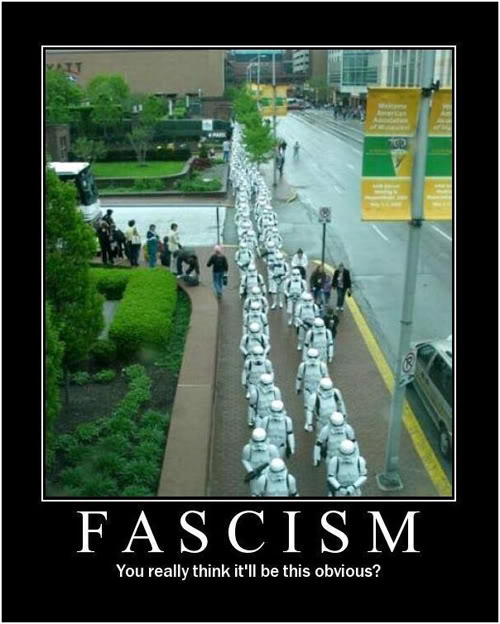
fascism

Is America evolving into a Fascist country? 8

First of all, let’s define Fascism.  According to Wikipedia which, due to their large eclectic environment of editors, is one of the more reliable, non-biased sites. Fascism is:

… a radicalauthoritarian nationalist political ideology.  Fascists advocate the creation of a totalitarian single-party state that seeks the mass mobilization of a nation through indoctrination, physical education, and family policy including eugenics. Fascists seek to purge forces and ideas deemed to be the cause of decadence and degeneration and produce their nation’s rebirth based on commitment to the national community based on organic unity where individuals are bound together by suprapersonal connections of ancestry, culture, and blood. Fascists believe that a nation requires strong leadership, singular collective identity, and the will and ability to commit violence and wage war in order to keep the nation strong. Fascist governments forbid and suppress opposition to the state.

Fascists promote violence and war as actions that create national regeneration, spirit and vitality. Fascists exalt militarism as providing positive transformation in society, in providing spiritual renovation, education, instilling of a will to dominate in people’s character, and creating national comradeship through military service.

Fascism is anti-communistanti-democratic, anti-individualist, anti-liberalanti-parliamentary, anti-bourgeois, anti-proletarian and anti-conservative. It entails a distinctive type of anti-capitalism and is typically, with a few exceptions, anticlerical Fascism rejects the concepts of egalitarianismmaterialism, and rationalism in favour of action, discipline, hierarchy, spirit, and will. In economics, fascists oppose liberalism (as a bourgeois movement) and Marxism (as a proletarian movement) for being exclusive economic class-based movements. Fascists present their ideology as that of an economically trans-class movement that promotes resolving economic class conflict to secure national solidarity. They support a regulated, multi-class, integrated national economic system.

_________________________________

Now, having defined what fascism is, here are 14 defining characteristics of fascism, according to Dr. Lawrence Britt who has examined the fascist regimes of Hitler (Germany), Mussolini (Italy), Franco (Spain), Suharto (Indonesia) and several Latin American regimes.  I found this rather unsettling as there are several characteristics I am seeing within our own country.  I do not want to point them out as I would rather have you, as the reader, determine if you see the same similarities that I do, without “guiding” you to them:

1. Powerful and Continuing Nationalism – Fascist regimes tend to make constant use of patriotic mottos, slogans, symbols, songs, and other paraphernalia. Flags are seen everywhere, as are flag symbols on clothing and in public displays.

2. Disdain for the Recognition of Human Rights – Because of fear of enemies and the need for security, the people in fascist regimes are persuaded that human rights can be ignored in certain cases because of “need.” The people tend to look the other way or even approve of torture, summary executions, assassinations, long incarcerations of prisoners, etc.

3. Identification of Enemies/Scapegoats as a Unifying Cause - The people are rallied into a unifying patriotic frenzy over the need to eliminate a perceived common threat or foe: racial , ethnic or religious minorities; liberals; communists; socialists, terrorists, etc.

4. Supremacy of the Military – Even when there are widespread domestic problems, the military is given a disproportionate amount of government funding, and the domestic agenda is neglected. Soldiers and military service are glamorized.

5. Rampant Sexism – The governments of fascist nations tend to be almost exclusively male-dominated. Under fascist regimes, traditional gender roles are made more rigid. Divorce, abortion and homosexuality are suppressed and the state is represented as the ultimate guardian of the family institution.

6. Controlled Mass Media – Sometimes to media is directly controlled by the government, but in other cases, the media is indirectly controlled by government regulation, or sympathetic media spokespeople and executives. Censorship, especially in war time, is very common.

7. Obsession with National Security – Fear is used as a motivational tool by the government over the masses.

8. Religion and Government are Intertwined – Governments in fascist nations tend to use the most common religion in the nation as a tool to manipulate public opinion. Religious rhetoric and terminology is common from government leaders, even when the major tenets of the religion are diametrically opposed to the government’s policies or actions.

9. Corporate Power is Protected – The industrial and business aristocracy of a fascist nation often are the ones who put the government leaders into power, creating a mutually beneficial business/government relationship and power elite.

10. Labor Power is Suppressed – Because the organizing power of labor is the only real threat to a fascist government, labor unions are either eliminated entirely, or are severely suppressed.

11. Disdain for Intellectuals and the Arts – Fascist nations tend to promote and tolerate open hostility to higher education, and academia. It is not uncommon for professors and other academics to be censored or even arrested. Free expression in the arts and letters is openly attacked.

12. Obsession with Crime and Punishment – Under fascist regimes, the police are given almost limitless power to enforce laws. The people are often willing to overlook police abuses and even forego civil liberties in the name of patriotism. There is often a national police force with virtually unlimited power in fascist nations.

13. Rampant Cronyism and Corruption – Fascist regimes almost always are governed by groups of friends and associates who appoint each other to government positions and use governmental power and authority to protect their friends from accountability. It is not uncommon in fascist regimes for national resources and even treasures to be appropriated or even outright stolen by government leaders.

14. Fraudulent Elections – Sometimes elections in fascist nations are a complete sham. Other times elections are manipulated by smear campaigns against or even assassination of opposition candidates, use of legislation to control voting numbers or political district boundaries, and manipulation of the media. Fascist nations also typically use their judiciaries to manipulate or control elections.

I found this rather unnerving.

___________________________

Source

About these ads

Did you know that the internet automatically filters your search results? Reply

Google, Facebook, amongst many other sites auto-filter your search results. Although this may be appealing to many people, myself amid a significant percentage of other internet searchers, prefer a myriad of results. Ideally, I want to see both sides of the issue if I am searching for an item in the news. Not just conservative, or not just liberal viewpoints. Or primarily mainstream news sites, as they themselves filter the news.

In this video by TED, you will see how the same search for “Egypt” resulted in quite different results.


Germany to shut down nuclear reactors by 2022 Reply

Angela Merkel has committed to shutting down all of the country’s nuclear reactors by 2022, a task said by one minister to be as mammoth as the project to reunite East and West Germany in 1990.

Monday’s announcement, prompted by Japan’s nuclear disaster, will make Germany the first major industrialised nation to go nuclear-free in decades. It gives the country just over 10 years to find alternative sources for 23% of its energy.

The move, hammered out at a mammoth 14-hour overnight sitting at the Bundestag, came amid mass nationwide protests against nuclear power and at a low point for the chancellor’s Christian Democratic party (CDU), support for which has crumbled at the ballot box in five regional elections this year.

Although the proposal was welcomed among the general population, who have long been opposed to nuclear power, it was a move derided by one of Merkel’s own MPs as “knee-jerk politics”.

The plan is to keep shut eight reactors which were suspended in March in the immediate aftermath of the Fukushima disaster, and to close the rest by 2022.

The phase-out must be ratified in parliament and is likely to face strong opposition from utility companies. On Monday a spokesman for the energy giant RWE said that “all legal options” were on the table.


Last week, grid operators warned the phase-out could result in winter blackouts – a prospect Merkel scoffed at . She insisted the decision would not lead to Germany simply importing nuclear power.

“We will generate our own electricity from other sources,” the chancellor told a press conference in Berlin. She said the plans would give Germany a chance to be a “trailblazer” for renewable energy, suggesting it could eventually earn, rather than cost, the country money.

Energy firms warned that the decision – a total policy reversal – would require significant investment in energy infrastructure. Philipp Rösler, new head of the FDP party, which rules in coalition with the CDU, agreed, likening the task ahead to that which faced Germany in 1990 after reunification. A study in 2009 showed that €1.3 trillion (£1.1tn) had been transferred from the West to rebuild the East.

This comparison was also made in an editorial by the left-leaning Tageszeitung newspaper on Monday, which said Merkel’s decision was “historic” and “a moment like the fall of the Berlin Wall”.

The government’s vocabulary seemed to consciously echo the reunification process, with Merkel heralding an “Energie-Wende” – “die Wende” is the word for change which became shorthand for the fall of communism and reunification.

Die Welt, a conservative daily, said the policy U-turn demonstrated a “creeping rejection of the economic model which has transformed Germany into one of the richest countries in the world”.

The French poured scorn on Germany’s decision. “Germany will be even more dependent on fossil fuels and imports and its electricity will be more expensive and polluting,” said the French industry minister, Éric Besson. German households pay twice as much for power than homes in France, where 80% of electricity comes from atomic plants, he said.

Germany last year was a net exporter of power to France, according to data from the French grid operator, RTE. This trend was reversed last month after the accident at Fukushima and Merkel’s decision to halt Germany’s oldest reactors.

“Germany’s energy policy will only work if there are improvements at the same time,” the EU energy commissioner, Günther Oettinger, said on Monday.

He said there was a need for better grid infrastructure, storage capacity and forward planning as well as a more pronounced rise in renewable supply.

Germany plans to cut electricity usage by 10% and double the share of renewable energy to 25% by 2020.

Merkel first mooted an accelerated exit from nuclear power within days of the Fukushima meltdown, ordering a three-month “moratorium” during which nuclear power could be debated.

It was a remarkable U-turn. In September 2010, she had committed to extending the lives of Germany’s 17 nuclear plants.

Many of her party are unhappy with her handling of the situation.

“Knee-jerk politics like the reaction to Fukushima does not pay dividends,” said Mike Mohring, the head of the CDU faction in the Thuringian state parliament, last week.

Among other G8 nations, only Italy has abandoned nuclear power.

Article from The Guardian

Incredible water-spout footage off of New South Wales coast of Australia Reply

Waterspouts fall into two categories: fair weather waterspouts and tornadic waterspouts.

Tornadic waterspouts are tornadoes that form over water, or move from land to water. They have the same characteristics as a land tornado. They are associated with severe thunderstorms, and are often accompanied by high winds and seas, large hail, and frequent dangerous lightning.

Fair weather waterspouts usually form along the dark flat base of a line of developing cumulus clouds. This type of waterspout is generally not associated with thunderstorms. While tornadic waterspouts develop downward in a thunderstorm, a fair weather waterspout develops on the surface of the water and works its way upward. By the time the funnel is visible, a fair weather waterspout is near maturity. Fair weather waterspouts form in light wind conditions so they normally move very little.

If a waterspout moves onshore, the National Weather Service issues a tornado warning, as some of them can cause significant damage and injuries to people. Typically, fair weather waterspouts dissipate rapidly when they make landfall, and rarely penetrate far inland.

Information from National Ocean Service website