 (Sept 6, 2011) Now with the Ten-Year Anniversary of 9/11 only a few days away, stories and facts have yet re-emerged like a hungry bear from it’s den after a long winters hibernation.
Therefore, while perusing the internet, I came across The Telegraphs “21 Awful Truths About 9/11“…
OMG!…. Here is number eight on the list:
“Three hours before the attacks, a machine called a Random Event Generator at Princeton University predicted a cataclysmic event was about to unfold.”
Since this one was new to me, I decided to do a bit of searching around on the internet to find the Princeton postings….
First of all, I would like to preface this that I DO NOT LIKE statistical analysis. Perhaps it is from my early college years when I was a computer programming major. CS majors were required to take a stats class in which we had to write with Pascal code (I know… I’m dating myself) to solve the statistical problem at hand. Talk about a double-whammy. I hated that class…. I believe it was shortly thereafter I realized that programming was not my cup-of-tea.
Following my change of major to a much more enjoyable computer graphics, graduation, then back to college (I was on the long-term plan… if there was such a beast as “Student” as a major, that would have been mine) to study geology and the earth sciences, I can still hear one of my geology professors carrying on about statistics…
“Statistical numbers must be used carefully. They can provide you with factual data, or a bunch of $#!&@!. It is no secret that the same set of statistics can be provided to several different groups. And each group, working independently of the others, are able to achieve different results dependent upon what outcome they are striving to achieve.”
In returning back to the topic at hand you will better understand why I rambled about my Geo Prof… (by the way, have I mentioned I DO NOT LIKE statistics?)…
Here is what I found on one of the Princeton sites:
1. download daily raw datafile for June 16 through September 20, 2001
2. calculate daily empirical mean and sd per egg
3. exclude any raw egg values less than or equal to 50 or more than or equal to 150, and eggs with daily empirical means > 103 or < 97, or sd > 6 or sd < 8 (these thresholds are used as indicators that the eggs malfunctioned; well over 99% of the egg data were usable)
4. use resulting mean & sd to calculate a t-score (199df) per egg, per day
5. t (199df) is approximately equal to z, calculate z-squared per egg
6. sum up all z-squares across eggs, per day, keeping track of the number of eggs
7. create 5-minute consolidations of the per-second data, as sums of z-squares
8. analyze data using 6 hour sliding window
9. calculate z score equivalent for the resulting chi-squares & df
10. calculate odds associated with the z scores
11. plot results
Then this site shows several different plots (I am only posting a few, but feel free to check them out yourself here.)
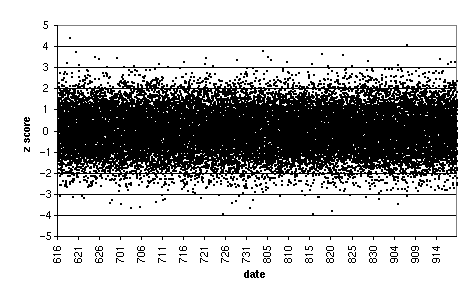
By the way, have I mentioned I DO NOT LIKE statistics?
Now, I am no dummy. In fact, I am a member of the Mensa Society with a tested IQ of 160. Having said this… what the hell is an egg?
I pondered doing a bit more studying so I could better understand what I just read, but my overwhelming dislike for statistics has taken control. So I look around the internet little further to see if I can find a Princeton site translating all this mumbo-jumbo. And I do find another site which is written in more proper English. So I read:
“The following material shows the behavior of the Global Consciousness Project’s network of 37 REG devices called “eggs” placed around the world as they responded during the periods of time specified in formal predictions for the events of September 11 2001.”
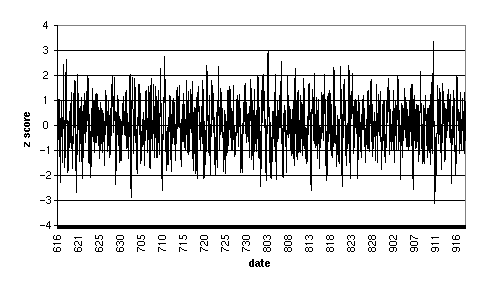 Well, there is my answer to the famous riddle, which came first… the chicken or the egg. I will take mine over-easy please. I now have my answer as to what an “egg” is.
After reading about Z-scores, Deviation of Means, and such (amid the flashbacks I was having of Pascal-Statistics), I finally come to:
“The graph of data [below] from the formal prediction for September 11 shows a fluctuating deviation throughout the moments of the five major events, during which ever-increasing numbers of people around the world are hearing the news and watching in stunned disbelief. Times of the major events are marked by boxes on the line of zero deviation. The uncertain fluctuation of the EGG data continues for almost half an hour after the fall of the second WTC tower. Then, at about 11:00, the cumulative deviation takes on a strong trend that continues through the aftermath period and ultimately exceeds the significance criterion. There were 37 eggs reporting on September 11, and over the 4 hours and 10 minutes of the prediction period, their accumlated Chisquare was 15332 on 15000 degrees of freedom. The final probability for the formal hypothesis test was 0.028, which is equivalent to an odds ratio of 35 to one against chance.”
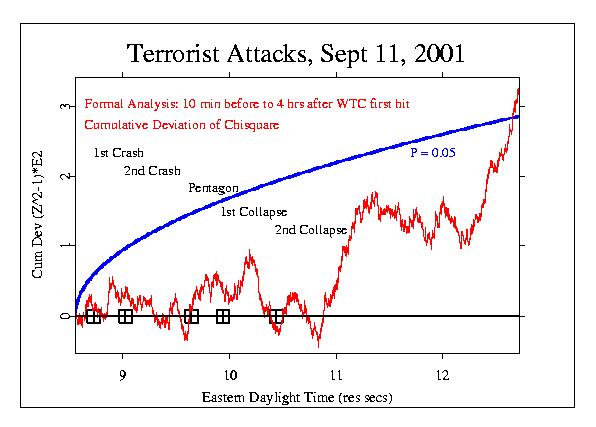
And then it goes into Deviation of Variance. By this time, I’ve had enough. The flashbacks are too overwhelming. (By the way, have I mentioned I DO NOT LIKE statistics?) Now, if you have made it this far in reading this… congratulations! There is a reason to my rambling, and here are MY thoughts and questions back to these Random Generator-ist-people….
Yes, I believe in randomness of the universe. I also believe in coincidence. Your generator coincided with a MAJOR catastrophic event. Okay… well, two events. Apparently it also predicted the bombing of the American Embassy in Africa in August 1998. What about all the OTHER catastrophic events it did NOT predict? Hurricane Katrina? Oslo killings? The earthquake and tsunami in Japan? Virginia Tech? Steve Jobs stepping as CEO of Apple? These are only a few of a long long list which has been occurring since your Frankenstein creation.
Can your generator… or better yet… YOU explain why these events were NOT predicted? If it has, please… send this my way. I’m dying to see all events having been predicted. Can it predict the next winning set of lottery numbers? If so… THEN you have something useful.
Just like my Geology Professor discussed, you took data and tied it to 911 simply because you wanted that correlation. I firmly believe this was coincidence. I do not believe any machine can predict the unknown, especially human action. It may be able to provide PROBABILITIES, but not on the randomness of human behavior. For the sake of your argument, though, let’s say a machine is able to predict human randomness … how do you know the flux in data was not intended to predict that a dog would be hit by a semi at that exact moment (well, 5 exact moments) it spiked? Shame on you, Princeton. I had thought much better of you than this. Okay… I’m getting too serious now. This whole idea has had me laughing so hard my deaf dog has been able to hear me. (you think I’m joking???)
The Random Generator did NOT PREDICT 9/11… it COINCIDED with it.
By the way… have a mentioned I HATE statistics????????????






 Motley News & Politics
Leave a reply to Anonymous Cancel reply